


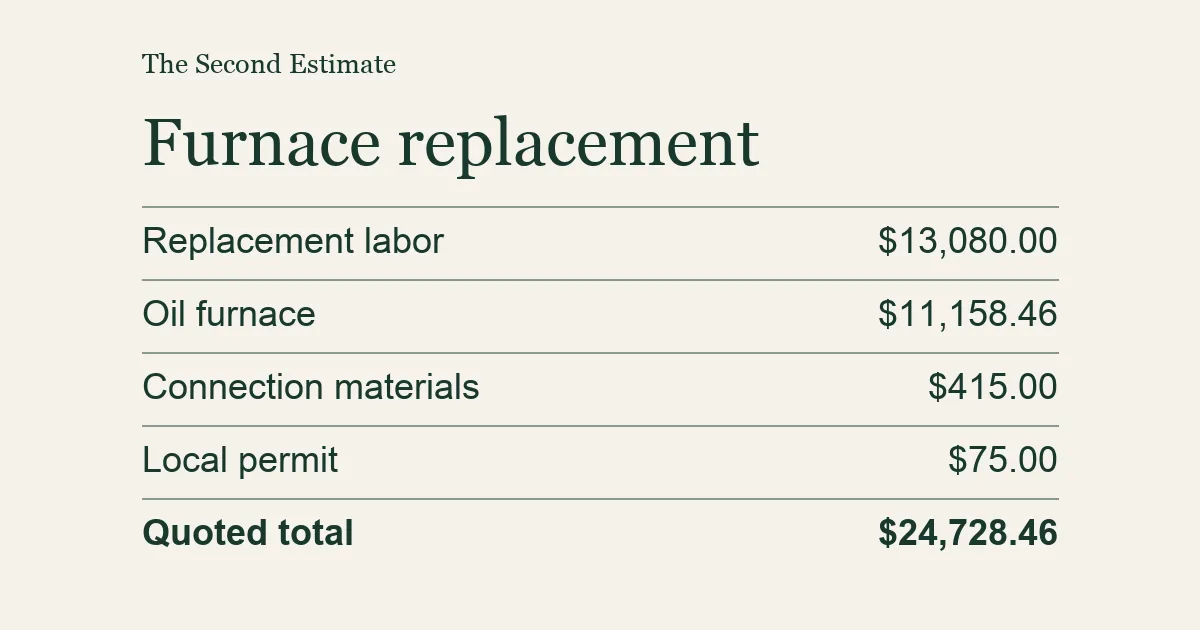
Inside a $24,728.46 furnace replacement estimate
The biggest number on this furnace quote is the cost of the crew. Energy Efficiency Services, Inc. quoted $13,080 for replacement labor and $11,158.46 for the furnace. Set those two lines beside a competitor’s single installed price and even an experienced advisor has a question to answer. Where did the other shop put the work?
The original is a December 17, 2024 quotation for a municipal building. Its value to a residential shop is the chance to read an actual offer all the way down to the fine print. The size of the furnace, the access conditions and the age of the quote limit what its price can tell you about a house today. We’ve transcribed the amounts in U.S. dollars and omitted the customer and job identifiers. The quotation appears on page 57 of the public meeting packet.
Line 1. Replacement labor · $13,080
The contractor priced the work of replacing a horizontal oil furnace as one job. The quantity of one tells the buyer how many replacements they are buying. It gives no basis for calculating a crew size or hourly rate. Labor accounts for roughly 53% of the total. If another bidder puts installation into its equipment price, comparing the two labor lines alone will give the customer the wrong impression.
A shop can make a fixed labor price easier to evaluate without opening its payroll. Write down what the crew will leave behind. For example, if startup testing and a walkthrough are part of your offer, name the person who will record the results and show the customer how to operate the controls. This quotation leaves those deliverables unspecified.
Line 2. Furnace and configuration · $11,158.46
The quote names a Boyertown oil furnace rated at 400,000 Btu as written. Four unpriced lines follow. One specifies a two-stage oil pump. Two describe airflow and the placement of the supply and return connections. The last names a Beckett burner. None carries an additional charge in the arithmetic. A two-stage pump describes the pump itself. It gives the reader no basis for promising two stages of heat output.
Those orientation notes are worth borrowing for residential proposals. A buyer might skim past them, but the installer needs to know which side of the cabinet the existing ducts meet. Here, the document gives both an airflow direction and side labels without stating the viewing position. Before ordering, match the proposed unit’s connection drawing to the site. The worksheet has room to record which existing connections the price assumes the crew can reuse.
Line 3. Connection materials · $415
One figure covers materials for duct, flue and oil-piping work. The quote gives no lengths or individual material prices. Read the $415 once. Dividing it into three equal allowances would invent a purchasing breakdown, and treating it as a cap would invent a contract term. If an advisor expects to reuse most of an existing flue, the homeowner needs to know what happens if inspection shows a section must be replaced. Put the answer in the change-approval field before the customer signs.
Line 4. Local permit · $75
The permit has a price and is already in the total. An advisor comparing this with a bid that says “permits by owner” can now identify a real difference in responsibility. The $75 line tells us little about the inspection appointment. If your shop books that visit, say who makes the call and whether the customer needs to be home.
The lines with no dollar amount
Removal of the old waste-oil furnace is expressly included. Counting a separate removal fee would overstate this bid. The next note gives a four-week equipment lead time. Someone trying to plan around a heating interruption needs two other dates from the contractor. When can the crew start after the unit arrives, and how long should the building expect to be without heat?
The four priced lines add up exactly: $13,080 + $11,158.46 + $415 + $75 = $24,728.46. The tax field is marked N/A and the subtotal carries straight through to the total. The printed terms exclude shipping and sales tax unless specified, allow prices to change after 30 days and refer to contractor and manufacturer warranty terms. Payment is listed as net 30. Equipment lead time, payment terms and price validity each run on a different clock. This document establishes the offer. It does not establish the amount eventually paid.
Put the quote into the proposal worksheet
Open the HVAC proposal worksheet and filled-in example, or download the blank worksheet. Enter $24,728.46 under installed price, with the tax notation beside it. Record the old unit’s removal under included work and the four-week equipment lead under scheduling. Leave installation duration open. Under warranty, request the equipment coverage and the contractor’s labor coverage separately. Under exclusions, flag freight for confirmation before treating the quoted total as a delivered price.
Now hand the worksheet to the person booking the job. If they can tell what to order but still need to call the advisor about freight, scheduling or closeout, you have identified the next edit to your own proposal.
Questions a second bidder should expect
Does the $415 cover all new ductwork? The quotation groups connection materials into a single amount and gives no extent of replacement. Ask the estimator to identify which runs stay and where new work stops.
Can I compare this total with a residential furnace bid? You can compare how the two contractors describe their commitments. A historical quote for one large municipal unit offers little evidence about a fair installed price for a house. For a residential comparison, work through two bids for the same furnace.




 Powered by Yolando